
Mathematics & Heuristic Thinking
Concepts, model-drawing and problem-solving heuristics aligned to MOE — the skill of turning a word problem into a bar model — in small 1:6 classes.
What does the Primary Maths programme cover?
- Whole numbers and the four operations
- Place value, mental strategies and accuracy
- Early algebraic thinking
- The foundation that sits directly on top of whole numbers, taught well ahead of the P6 syllabus
- Fractions, decimals, ratio and percentage
- The topics that trip up the most children at PSLE
- Measurement and geometry
- Area and perimeter, volume, angles and properties of shapes
- Statistics
- Reading and interpreting tables, bar graphs, line graphs and pie charts
- Heuristics and model-drawing
- Bar models, working backwards, guess-and-check, patterns
- Problem sums
- Turning words into maths — the skill the PSLE really tests
One of the most advanced and up-to-date maths curricula in Singapore
That is a large claim, so here is exactly what it rests on — and you can see most of it for yourself further down this page.
- Practice built from papers the schools actually set — questions drawn from top-school end-of-year papers as recent as 2025, each one carrying its school, year and mark allocation.
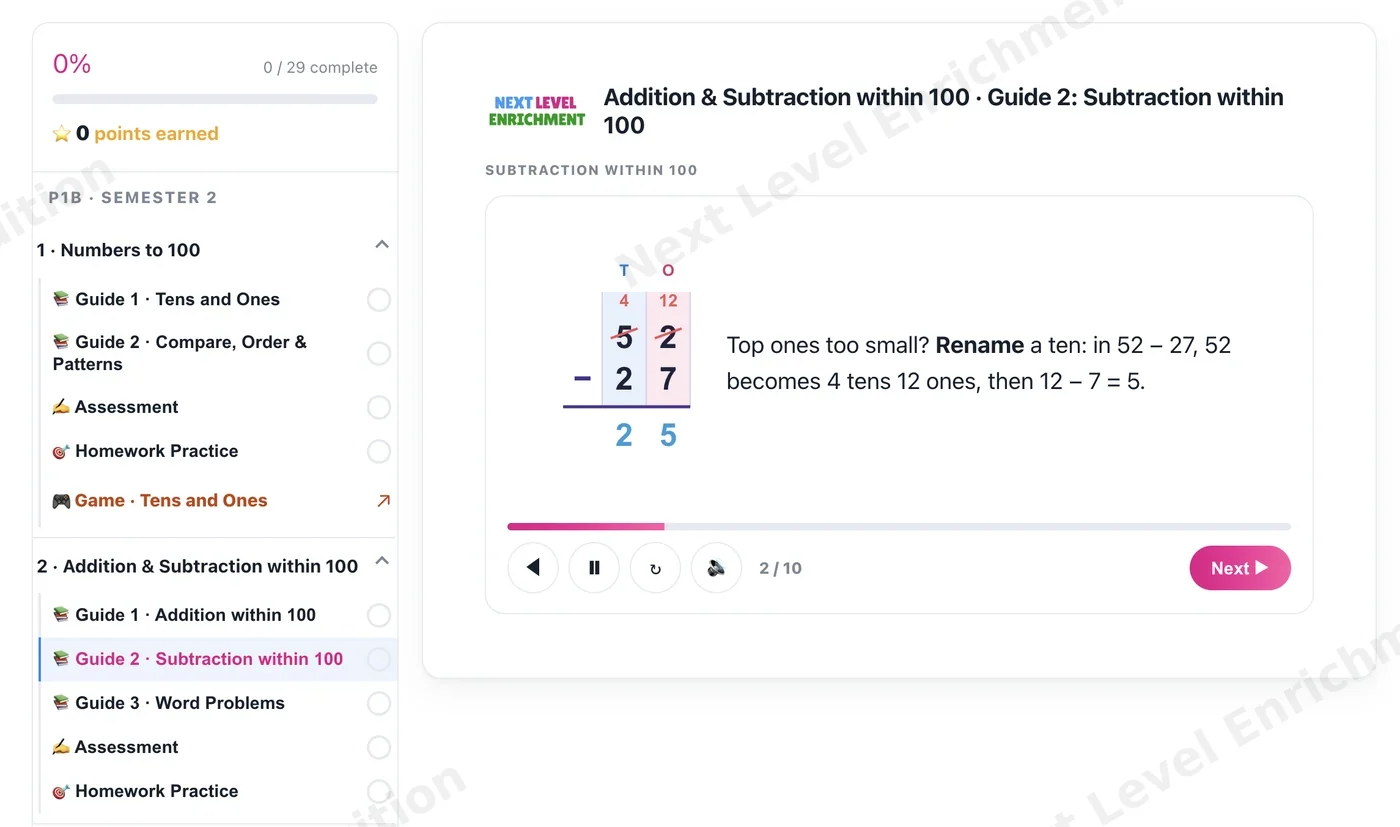
- Guided e-learning that works through a method one line at a time, at your child’s own pace, with every step replayable.
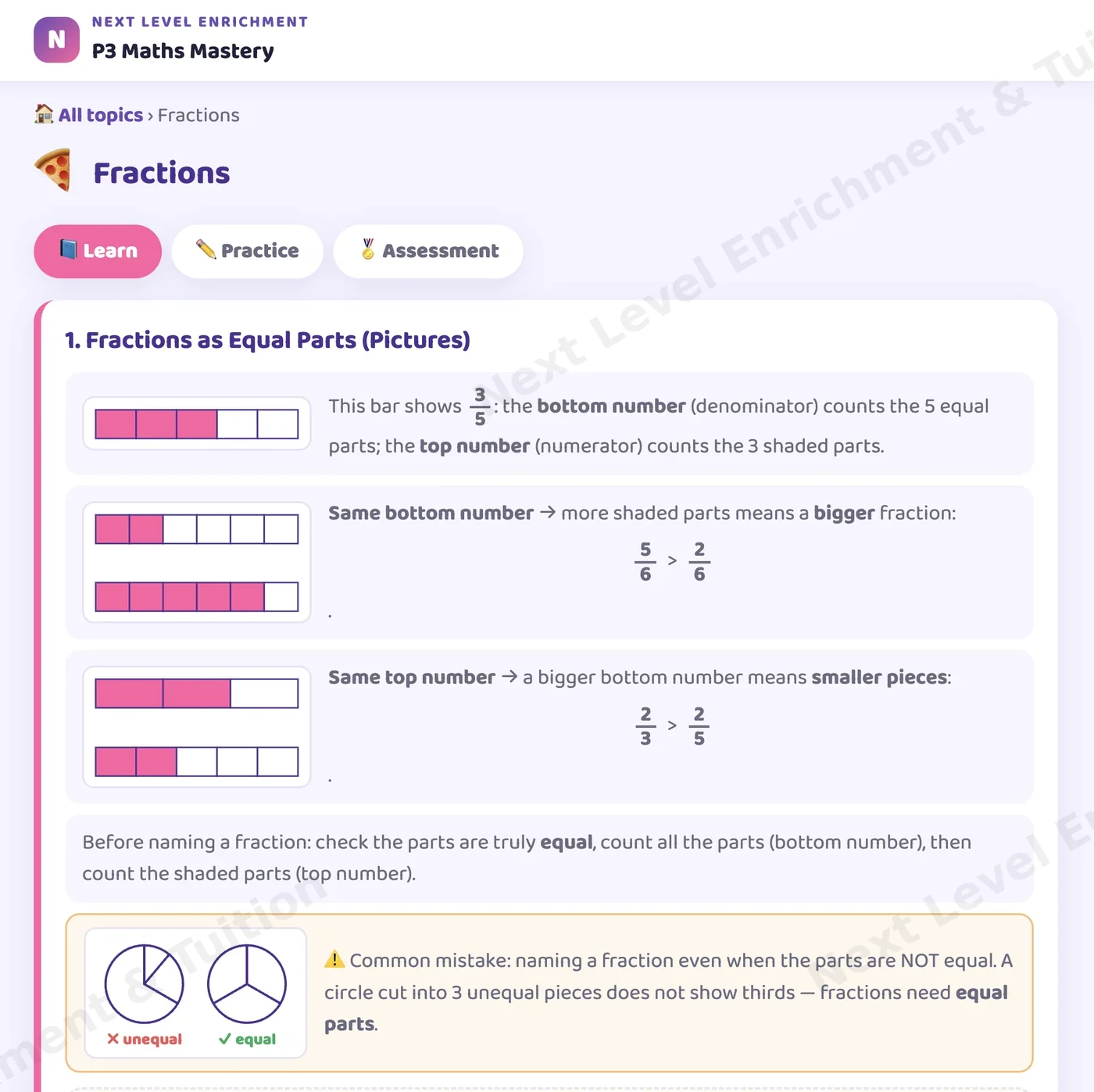
- Topic mastery apps running Learn, then Practice, then Assessment — so understanding is checked before a child moves on.
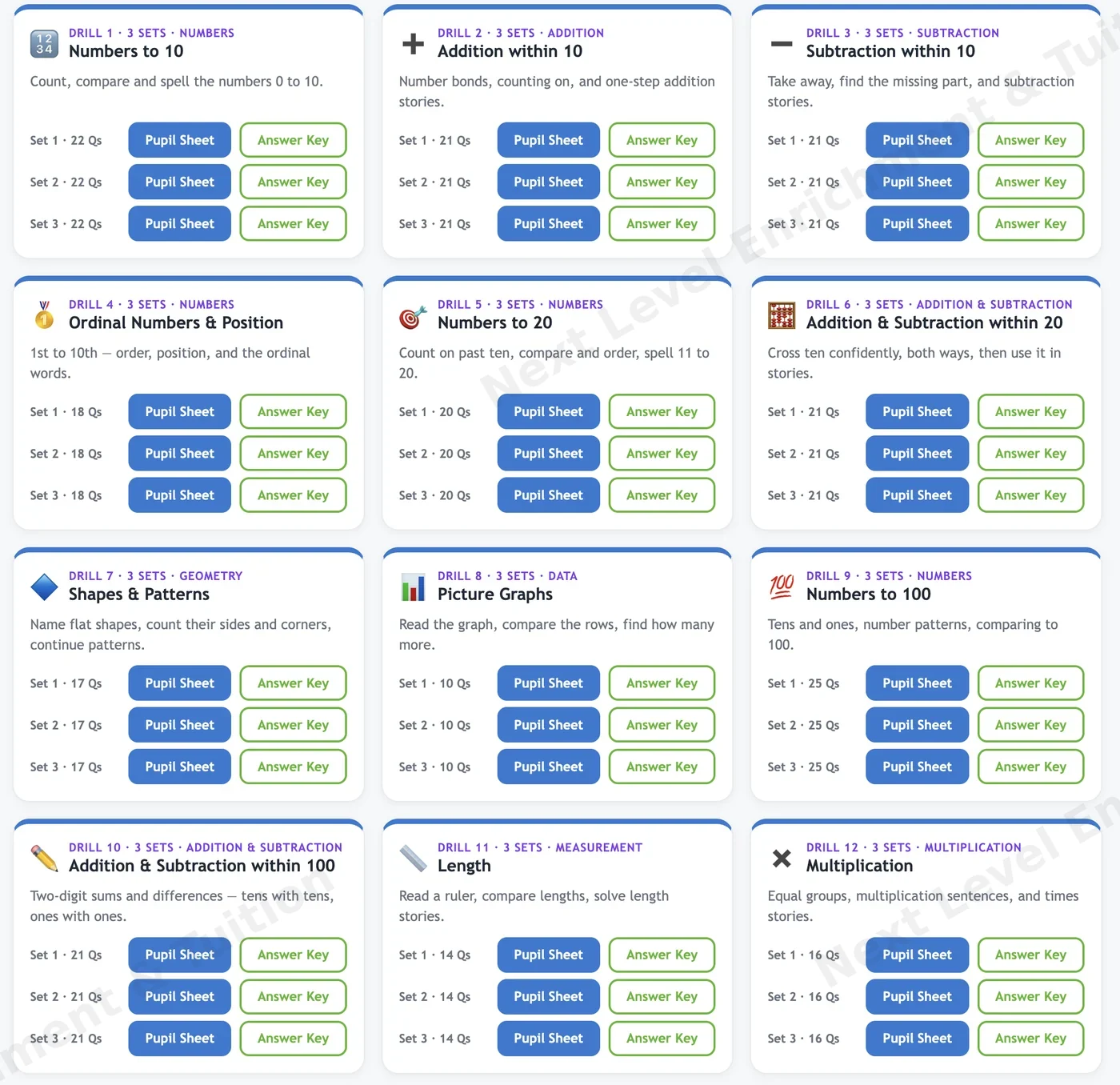
- A full drill library — twelve topics, three sets each, every sheet with its matching answer key.
- Heuristics taught as named strategies, each shown with the PSLE questions that actually use it.
Reviewed every term against the latest MOE syllabus and the newest school papers, so what your child practises is what is currently being examined.
A look inside our primary maths materials
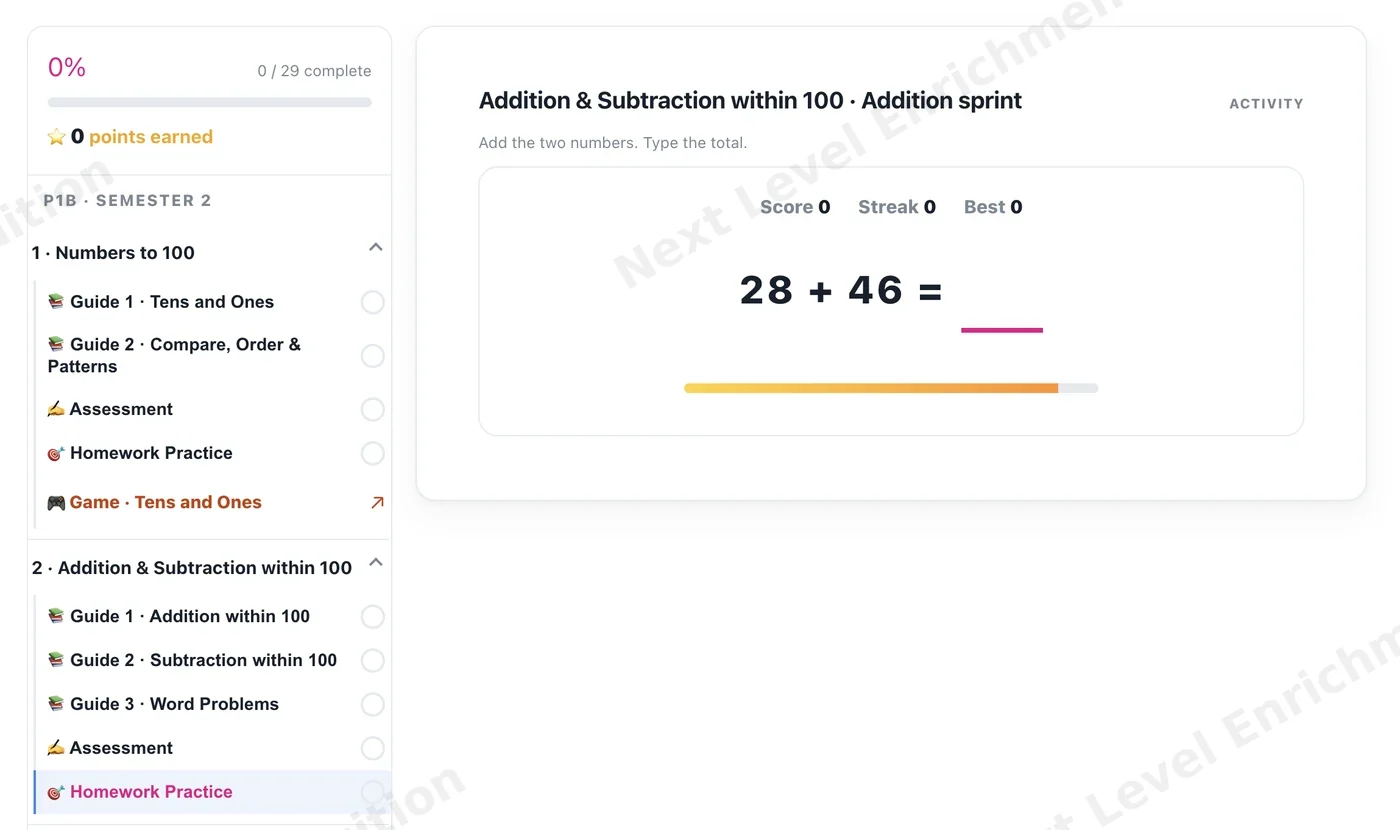
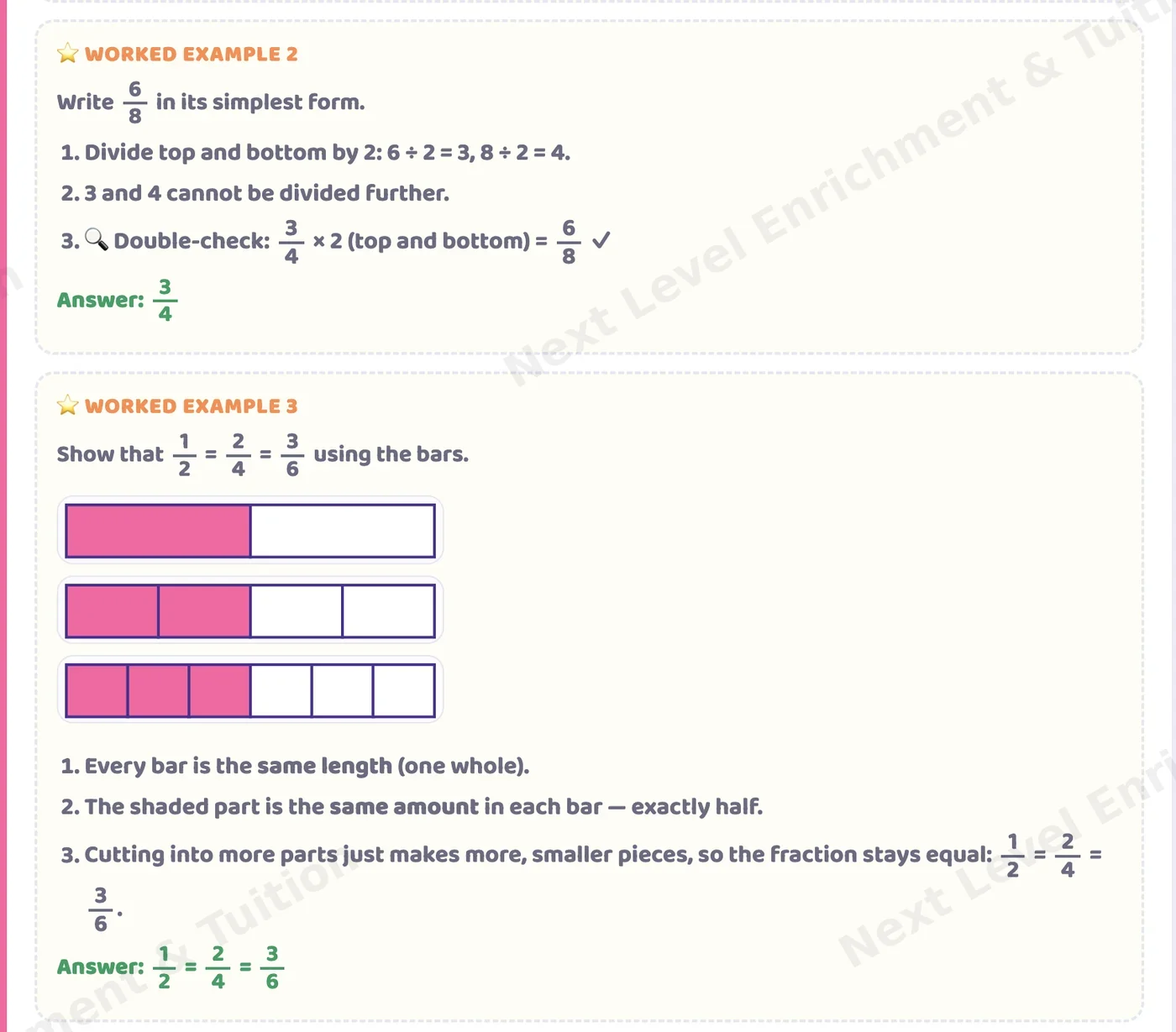
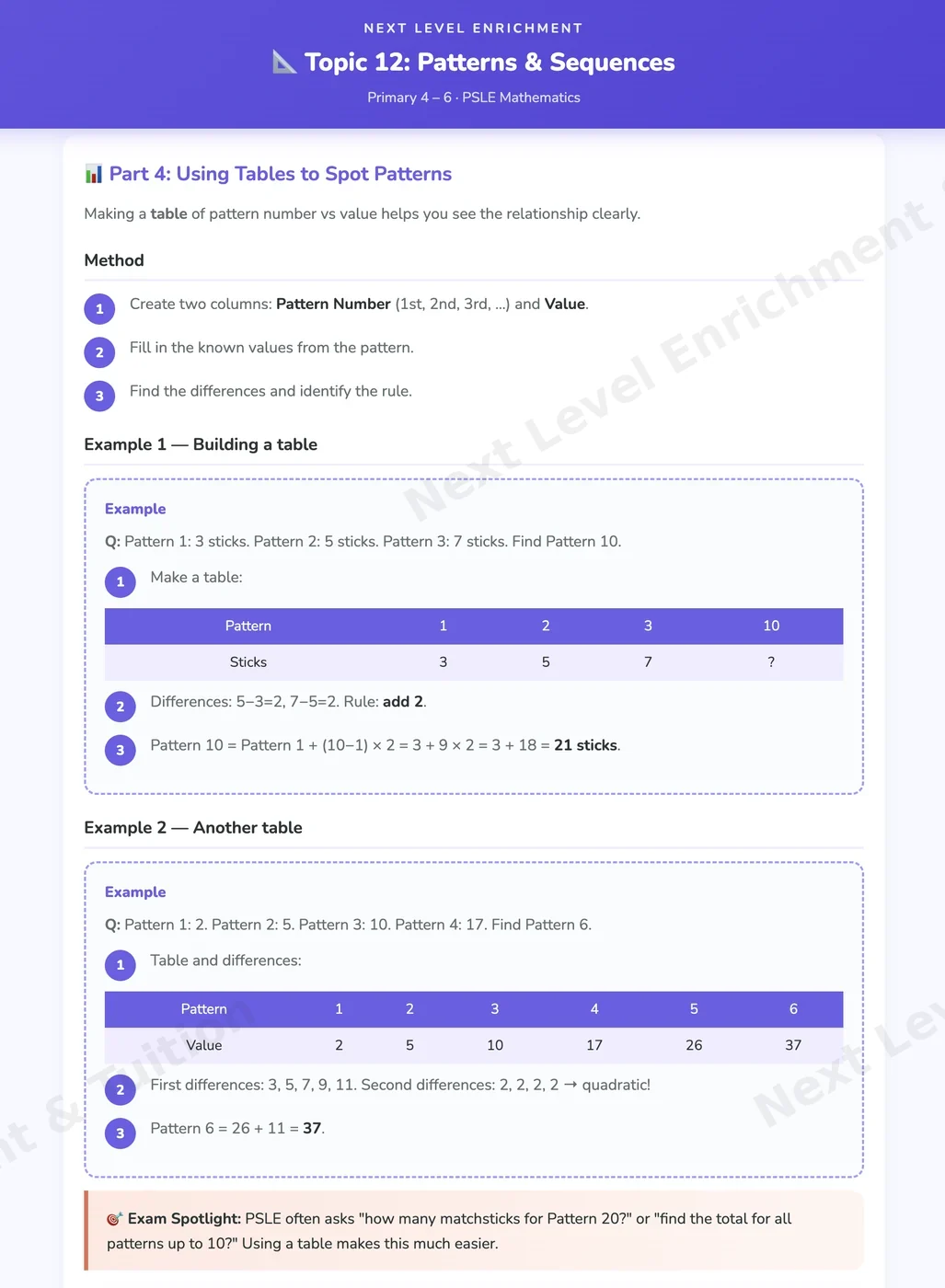
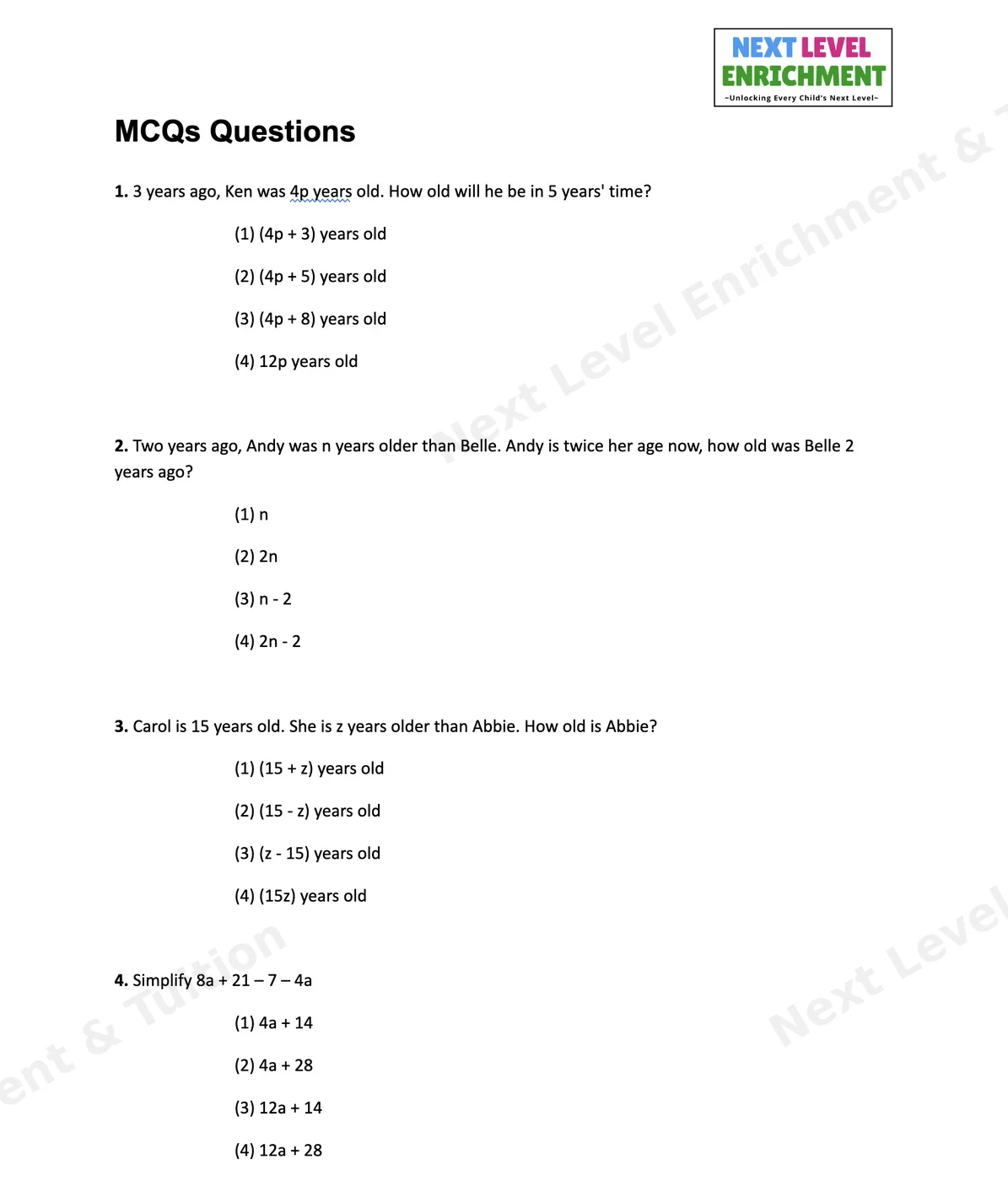
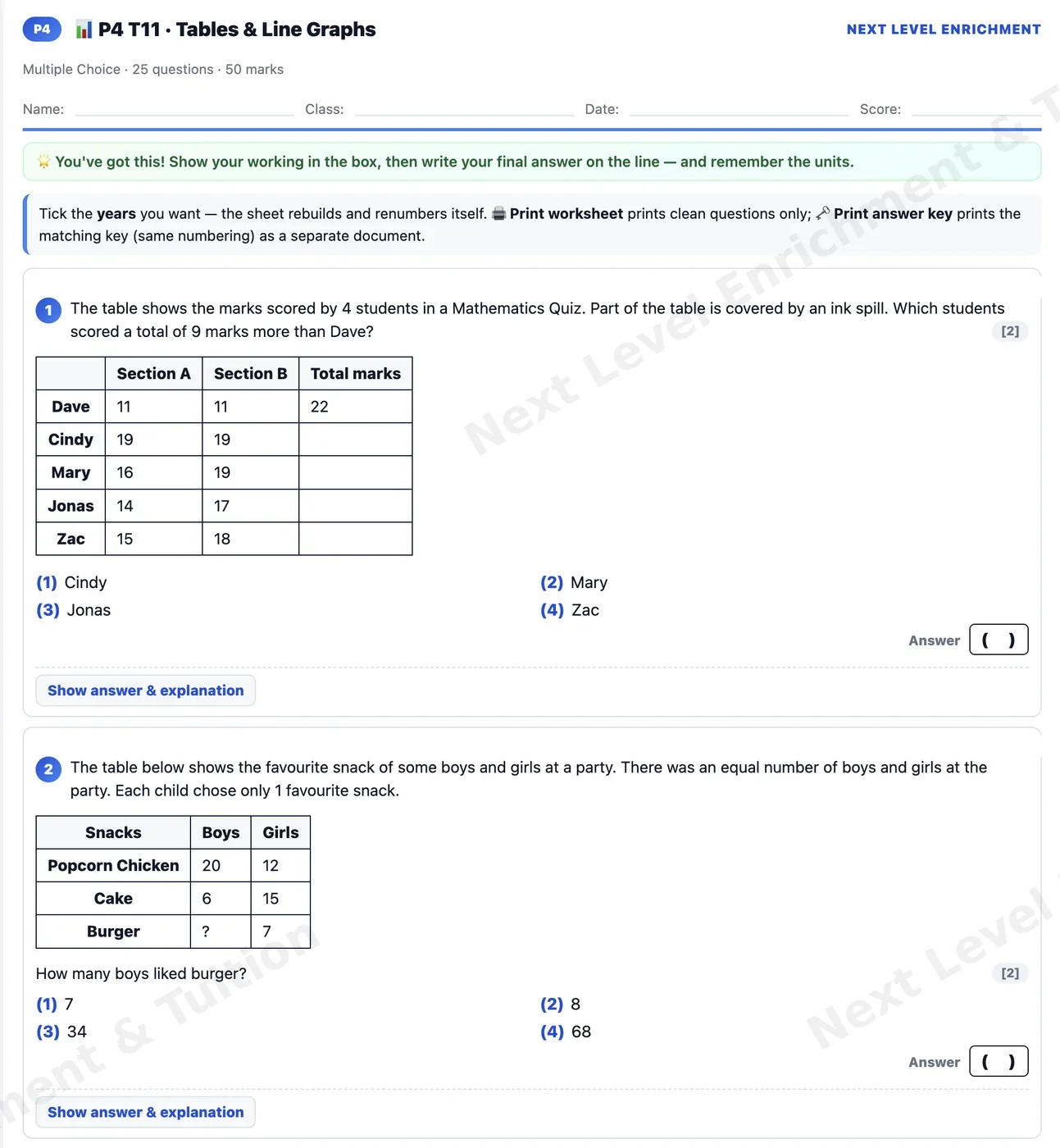
Printed drill sheets, guided e-learning, topic mastery apps and a searchable bank of top-school questions — all written and built in-house, and all used in class. Browse a few real samples below (tap any page to see it full size).
Common questions from parents
Why is model-drawing so important?
The bar model is the MOE-endorsed bridge from a paragraph of English to a piece of maths. Most children who 'know their maths' but score badly are not weak at arithmetic — they cannot translate the question into a diagram. A child who can draw the bar correctly has usually already solved the problem, which is why Next Level Enrichment teaches it as a core skill, not an afterthought.
Why do you introduce algebra so early?
Algebra is the foundation that sits directly on top of whole numbers, and once a child is comfortable with it, a surprising number of PSLE topics turn out to be algebra in disguise — ratio, rate and percentage, and many of the heuristics, all rest on the same idea of working with an unknown quantity. Next Level Enrichment introduces algebraic thinking well ahead of the P6 syllabus, so by the time it appears formally, it is already familiar rather than new. A child who reaches this stage early solves problem sums faster, since they recognise the underlying structure instead of hunting for a method each time.
How does Next Level Enrichment make maths stick?
Step by step, with the working visible. In a 1:6 class the teacher sees each child's method, not just the answer — a wrong answer with sound reasoning and a right answer by luck look identical on a marked script, and only one of them tells you what to teach next. Short videos and games reinforce each concept between lessons.
How do you make sure a child can actually apply what they've learnt?
We work through questions live, thinking aloud so a child sees how to start a problem, not just the final answer. Students are then tested on similar questions on their own, and asked to explain their method back to us in plain language — the Feynman method. If a child cannot explain a step simply, that step is not yet understood, however correct the final answer looks, and that is exactly where we go back and reinforce it.
Learning beyond the classroom
Your child can practise free right now with our maths apps — all aligned to the MOE syllabus, no sign-up needed.
Preparing for the PSLE specifically? PSLE Maths tuition in Ang Mo Kio →
Last updated: 2026-07-14. Syllabus coverage follows the Singapore MOE syllabuses.
Book a trial lesson at our Ang Mo Kio centre
Next Level Enrichment, Blk 709 Ang Mo Kio Ave 8, #02-2593, Singapore 560709. Message us and we will tell you honestly whether this programme is the right fit for your child.